Cyber Awareness Session for students of AIDS CSE and IoTCSBCT on 8th October 2026
Cyber Awareness Session for students of AIDS CSE and IoTCSBCT on 8th October 2026
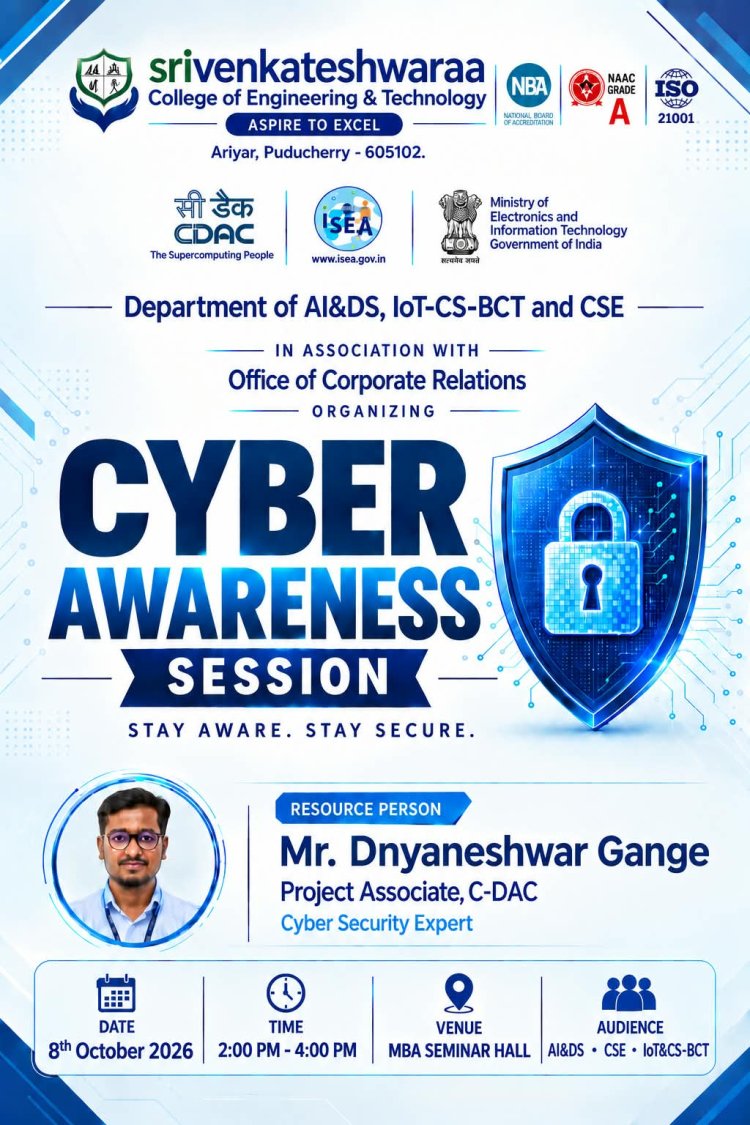
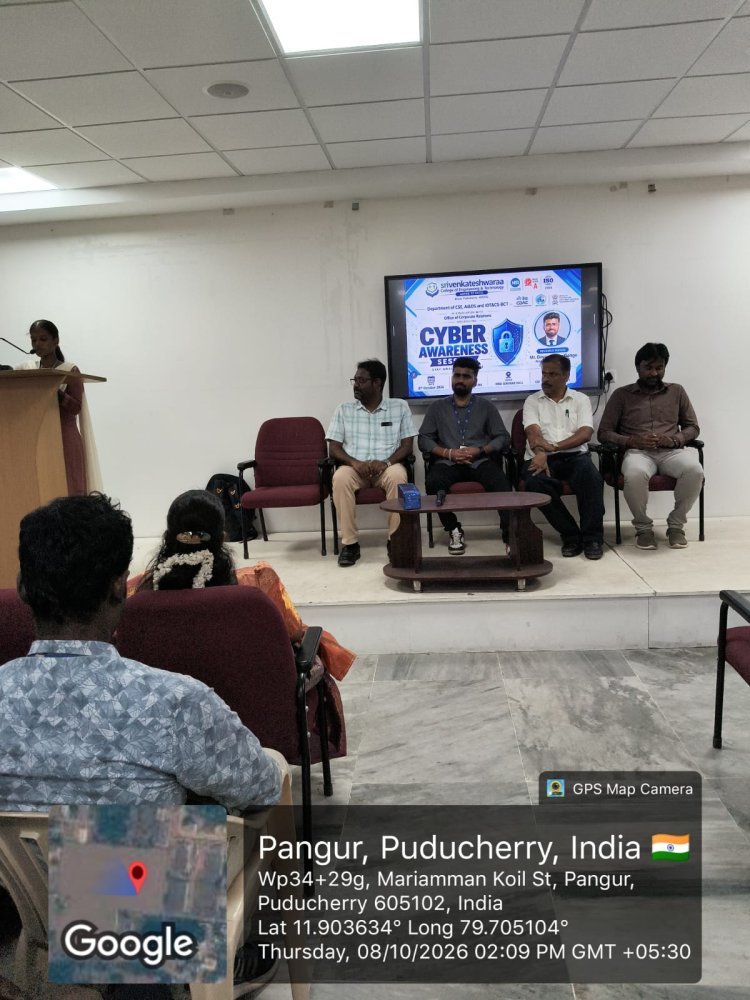
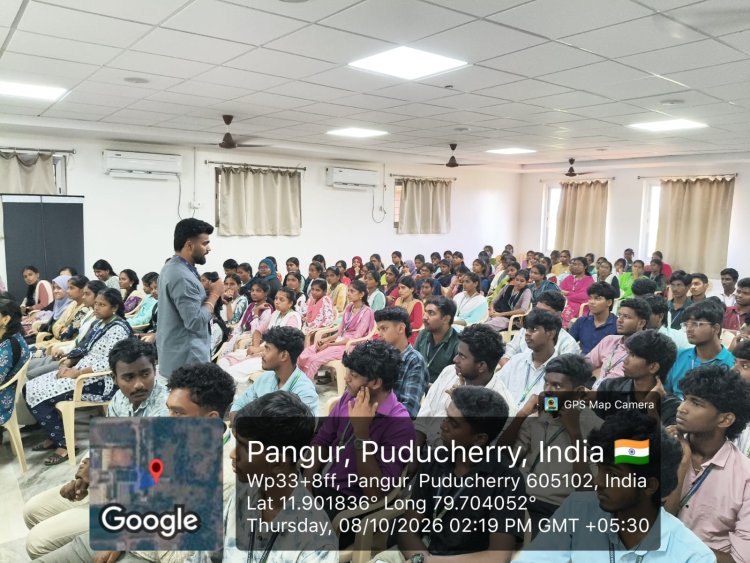
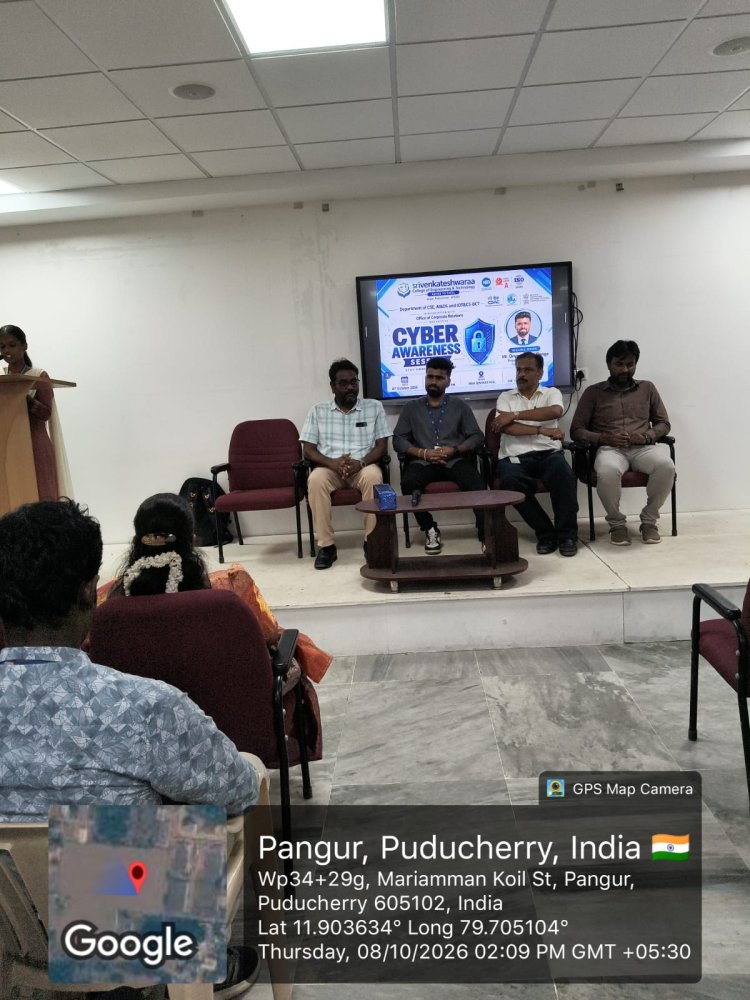
CYBER AWARENESS SESSION
Theme: “Stay Aware. Stay Secure.”
Srivenkateshwaraa College of Engineering & Technology
Ariyur, Puducherry – 605102
The programme was organized by the following departments:
- Department of Artificial Intelligence & Data Science (AI&DS)
- Department of IoT, Cyber Security with Blockchain Technology (IoT-CS-BCT)
- Department of Computer Science and Engineering (CSE)
The programme was organized in association with the Office of Corporate Relations.
The initiative was supported through association with prominent organizations/institutions represented in the programme publicity material, including:
- Centre for Development of Advanced Computing (C-DAC)
- Information Security Education and Awareness (ISEA)
- Ministry of Electronics and Information Technology (MeitY), Government of India
|
Particular |
Details |
|
Date |
8 October 2026 |
|
Day |
Thursday |
|
Time |
2:00 PM – 4:00 PM |
|
Venue |
MBA Seminar Hall |
|
Target Audience |
Students of AI&DS, CSE and IoT-CS-BCT |
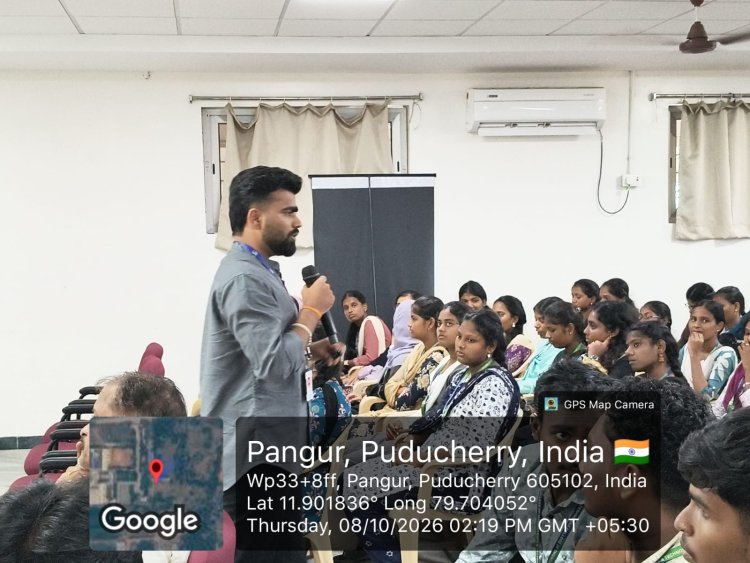
The Cyber Awareness Session featured:
Mr. Dnyaneshwar Gange
Project Associate, C-DAC
Cyber Security Expert
The resource person brings professional expertise in the field of cybersecurity and was invited to provide students with practical awareness regarding cyber threats, safe digital practices and the importance of information security.
In the present digital era, students and young professionals make extensive use of computers, smartphones, online banking, social media, cloud services, educational platforms and other internet-based services. While digital technologies provide numerous benefits, they also expose users to a variety of cybersecurity threats.
Cyberattacks such as phishing, identity theft, password attacks, malware, ransomware, online fraud, social engineering and unauthorized access are becoming increasingly sophisticated. Therefore, developing cybersecurity awareness among students is an important requirement for creating responsible and secure digital citizens.
Recognizing the importance of cybersecurity education, Srivenkateshwaraa College of Engineering & Technology, Ariyur, Puducherry, organized a Cyber Awareness Session for students of AI&DS, CSE and IoT-CS-BCT.
The programme was conducted with the objective of creating awareness about the growing cyber threat landscape and educating students about responsible, secure and safe use of digital technologies.
The major objectives of the Cyber Awareness Session were:
- To create awareness about cybersecurityamong students.
- To familiarize students with common cyber threats and online attacks.
- To educate students about phishing and social engineering attacks.
- To emphasize the importance of using strong and unique passwords.
- To encourage the use of appropriate security mechanisms such as multi-factor authentication.
- To make students aware of the risks associated with sharing personal information online.
- To promote safe practices while using social media and digital platforms.
- To explain the importance of protecting personal, academic and financial information.
- To encourage students to identify suspicious links, emails, websites and messages.
- To develop a culture of cybersecurity awareness and responsible digital citizenship.
- To provide students with professional exposure to the field of cybersecurity.
- To motivate students to consider cybersecurity as an important area of study and career development.
The Cyber Awareness Session was designed as an awareness-oriented academic programme focusing on the practical aspects of cybersecurity.
A. Understanding Cyber Threats
Students were introduced to the nature of cyber threats and the ways in which individuals and organizations can become vulnerable to cyberattacks.
The session emphasized that cyber threats are not limited to large organizations. Individual users, students and educational institutions can also become targets.
B. Phishing Awareness
One of the important areas of cybersecurity awareness is recognizing phishing attempts.
Students can encounter fraudulent:
- Emails
- SMS messages
- Social media messages
- Website links
- Login pages
- Job offers
- Scholarship messages
- Banking notifications
The session highlighted the importance of verifying the authenticity of such communications before clicking links or sharing confidential information.
C. Password Security
The importance of maintaining secure passwords was another significant aspect of cybersecurity awareness.
Students were encouraged to:
- Use strong passwords.
- Avoid easily predictable passwords.
- Avoid using the same password for multiple accounts.
- Keep passwords confidential.
- Use additional authentication mechanisms whenever available.
D. Protection of Personal Information
Students were made aware of the importance of protecting sensitive personal information such as:
- Usernames and passwords
- Mobile numbers
- Email credentials
- Banking information
- Identification details
- Academic information
- Personal photographs and documents
The session reinforced the principle that information shared online may be difficult to completely recover or remove.
E. Safe Use of Social Media
Social media platforms are an important part of students' daily lives. However, excessive sharing of personal information can create security and privacy risks.
Students were encouraged to exercise caution while:
- Accepting unknown friend/follow requests
- Sharing personal photographs
- Revealing locations
- Posting personal information
- Responding to unknown messages
- Clicking suspicious links
F. Responsible Digital Behaviour
Cybersecurity is not only a technical issue. It also depends on the behaviour and awareness of individual users.
Students were encouraged to become responsible digital citizens by following safe online practices and reporting suspicious cyber activities.
The involvement of C-DAC and the presence of a cybersecurity expert as the resource person added professional relevance to the programme.
C-DAC is associated with advanced computing and technology initiatives, making the participation of a C-DAC professional particularly valuable for students pursuing technology-oriented disciplines.
The interaction with an industry-oriented cybersecurity expert can help students understand the practical relevance of cybersecurity beyond classroom concepts and appreciate the growing demand for cybersecurity professionals.
The programme was particularly relevant to students from:
Artificial Intelligence & Data Science
AI and data-driven systems handle large volumes of information. Cybersecurity awareness is essential for protecting data, AI systems and digital infrastructure.
Computer Science and Engineering
Cybersecurity is closely connected with computer networks, operating systems, databases, software development and information systems. Awareness of security principles is therefore an important component of CSE education.
IoT and Cyber Security with Blockchain Technology
IoT devices and connected systems introduce additional cybersecurity challenges because they communicate through networks and may collect sensitive information. Cybersecurity is also fundamental to secure blockchain-based and distributed applications.
Thus, the session had multidisciplinary relevance across all three departments.
After participating in the Cyber Awareness Session, students are expected to be able to:
- Identify common cyber threats.
- Recognize suspicious emails, messages and links.
- Understand the importance of password security.
- Follow safer online browsing practices.
- Protect personal and confidential information.
- Understand basic social engineering risks.
- Exercise caution while using social media.
- Adopt responsible digital behaviour.
- Appreciate the importance of cybersecurity in modern technological systems.
- Develop greater interest in cybersecurity education and careers.
The Cyber Awareness Session is significant because cybersecurity has become an essential component of modern education and professional life.
Students are future engineers, technology professionals, entrepreneurs and researchers. Their work will increasingly involve digital platforms, cloud computing, artificial intelligence, Internet of Things, software systems and networked infrastructure.
Therefore, cybersecurity awareness at the student level can contribute to:
- Safer use of digital technologies
- Better protection of personal information
- Reduced vulnerability to cyber fraud
- Responsible use of online services
- Improved understanding of cyber risks
- Development of cybersecurity-conscious professionals
As a follow-up to the awareness programme, students should be encouraged to adopt the following practices:
- Think before clickingunknown links.
- Verify the senderbefore responding to emails or messages.
- Never disclose passwords, OTPs or authentication credentials.
- Use strong and unique passwords.
- Enable multi-factor authenticationwherever possible.
- Keep operating systems and applications updated.
- Install software only from trusted sources.
- Avoid using unsecured public networks for sensitive transactions.
- Maintain appropriate privacy settings on social media.
- Back up important academic and personal data.
- Report suspicious cyber incidents promptly.
The Cyber Awareness Session organized by the Department of AI&DS, IoT-CS-BCT and CSE, in association with the Office of Corporate Relations, represents an important initiative towards developing cybersecurity awareness among students.
The participation of Mr. Dnyaneshwar Gange, Project Associate, C-DAC and Cyber Security Expert, provides an opportunity for students to gain professional perspectives on cybersecurity and understand the importance of secure digital practices.
In an increasingly connected world, cybersecurity awareness is no longer limited to IT professionals. Every student and digital user has a role to play in protecting personal information, institutional resources and digital infrastructure.
The central message of the programme—“Stay Aware. Stay Secure.”—appropriately emphasizes that awareness is the first and most important step towards effective cybersecuri
What's Your Reaction?